Zooming in and out on Galaxy Evolution
Georg Rieger (rieger@phas.ubc.ca) and Brett Gladman (gladman@astro.ubc.ca)
All are welcome to this event!

Abstract:
Galaxies are fascinating yet complex celestial objects. Initial density perturbations determine the large-scale environments from which galaxies form. Stars are born in dense cores of molecular clouds, and in their final throes they enrich galaxies with metals and dust. At the heart of each galaxy is a supermassive black hole, whose growth is powerful enough to sweep the galaxy clean of gas and cease its future activity. Galaxy evolution is thus driven by myriad processes, such as gravitational interactions, and gas heating / cooling leading to phase transitions. Decades of astronomical observations have consolidated evidence that galaxies form stars at varying rates and efficiencies. What factors govern how galaxies form stars? What role does the cosmological-scale environment play in the life and fate of galaxies
In this colloquium, I will outline the key research questions in the field of galaxy evolution, and provide highlights on recent progress by my team in addressing these burning questions, including new results obtained using the James Webb Space Telescope. In context of the anticipated advancements in telescope capabilities in the next decade, I will also describe avenues for junior students to join the endeavour in leading and contributing to future discoveries.
Bio:
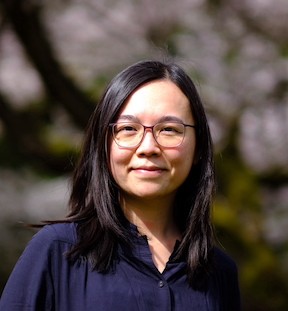
Dr. Allison Man uses the most advanced telescopes to study how massive galaxies like our own Milky Way came to be. She investigates the physics behind starburst activity, colliding galaxies and supermassive black holes. She co-chairs the Distant Galaxies Working Group of the Gemini Infrared Multi Object Spectrograph consortium. Before joining UBC as an Assistant Professor, she held postdoctoral fellowships at the European Southern Observatory and the University of Toronto. She obtained her PhD in Astrophysics at the Niels Bohr Institute at University of Copenhagen. She was awarded the Talent Prize by the Network for Women in Physics of the Danish Physical Society.
In parallel to her research pursuits, she has contributed to projects promoting astronomy education and research in Africa: she initiated and coordinated the ESO Astronomy Research Training in Ghana, and organized and instructed at The Pan-African School for Emerging Astronomers. She is passionate about using astronomy to raise public interest in STEM. She is regularly invited to give public talks in Vancouver, across Canada and internationally, and has served on the Board of Directors of the H. R. Macmillan Space Center since 2022.
Learn More:
- About the James Webb Space telescope: https://science.nasa.gov/mission/webb/
- About the Gemini Infrared Multi-Object Spectrograph (GIRMOS): https://www.dunlap.utoronto.ca/girmos-gemini-infrared-multi-object-spectrograph/ and https://noirlab.edu/science/news/announcements/sci23046
- Watch a video on GIRMOS by NOIRLAb Science: https://www.youtube.com/watch?v=Uhw14jKOdQw
- About supermassive black holes from the European Space Agency: https://www.esa.int/Science_Exploration/Space_Science/Webb/Webb_spots_greedy_supermassive_black_hole_in_early_Universe
- Watch a video on Black holes by Cambridge University: https://www.youtube.com/watch?v=U1GZZktCkn8
- About Galaxies: https://science.nasa.gov/universe/galaxies/
- View some beautiful galaxies from the Hubble telescope archives: https://esahubble.org/images/archive/category/galaxies/
- View some beautiful galaxies from the Hubble telescope archives: https://esahubble.org/images/archive/category/galaxies/