MOST data lead to description of densest known planet
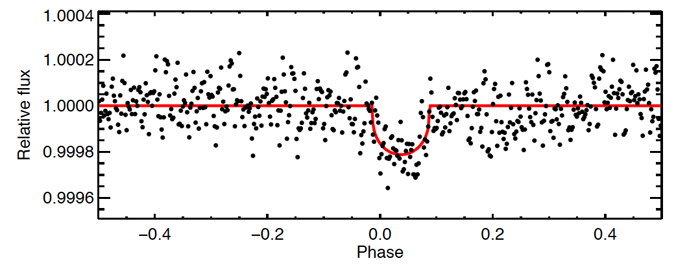
The MOST satellite has detected transits by the inner most planet of orbiting the star 55 Cancer. Analysis of the data combined with previously published doppler measurements of the star, lead to a description of a "rocky planet that is as dense as lead and where a year lasts less than 18 hours".
Uncertainty as to the correct orbital period of the innermost planet (denoted by the letter "e'), led to the star being place on the space telescope MOST's, observing schedule. Ultraprecise optical photometry was obtained spanning a nearly continuous 14.5-day interval and transits of planet "e" were detected at the period of 0.736540 days as suggested by Dawson & Fabrycky 2010. "On this world, the densest solid planet found anywhere so far, in the solar system or beyond, you would weigh three times heavier than you do on Earth," said Jaymie Matthews in a statement.
The microsatellite, which orbits the Earth as part of a Canadian Space Agency mission, carries a 15 cm telescope and CCD photometer which measures visible light. Matthews is the mission scientist who leads the MOST team. Other UBC researchers contributing to this work are Thomas Kallinger, Diana Dragomir and former student Jason F. Rowe.
Read the paper A SUPER-EARTH TRANSITING A NAKED-EYE STAR on arxiv.org.
Also see the story Exotic planet is densest of its kind on CBCNews.